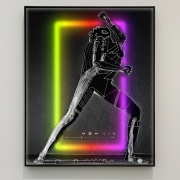

Reclining Muse of Sword & Brush

Reclining Muse of Sword & Brush
My life and artistic practice have been deeply inspired by Eastern cultures, particularly India, China, Japan, and Tibet. Since my teenage years, I have been drawn to their metaphysical traditions and contemplative practices. Meditation, ritual, and martial arts were not hobbies for me; they became lifelong disciplines. Through years of study and devotion to traditional Eastern martial arts, I trained body, heart, and mind as one unified system.
Over time, I developed my own structure of practice. This, too, is part of the tradition: true mastery emerges when inherited forms are absorbed and then embodied in a way that reflects one’s own nature. The practice becomes personal. It becomes alive.
This principle is especially evident in brush-based meditative traditions, where a single stroke expresses life force energy. The mark on the surface reveals the alignment of mind, heart, and body in a unified flow state. The finished work represents both the discipline and its realization. It is simultaneously practice and result. Each piece becomes a reflection of something universal, what many traditions call source, all that is, love, or God, expressed through the distinct personality of the hand that channels it.
Across cultures, whether through exchanges along the Silk Road or through parallel spiritual evolution, humanity has expressed similar foundational truths. These truths are shaped by culture and tradition so they can be understood within a given society, yet their essence remains the same.
My own cultural foundation was formed in New York City during the vibrant art scene of the early 1980s. The photographers, painters, and experimental artists of that time gave me a language of contemporary expression. I was influenced by Zen calligraphy and mandalas as much as by the bold line work of Keith Haring, the indigenous shamanic art of the Americas, the photography of Robert Mapplethorpe and Helmut Newton, as well as the visual culture of magazines and European erotic photography. These influences converged within me.
My task was not to judge or suppress them, but to channel them clearly. This required discipline. My training in Shaolin practices cultivated daily devotion and internal clarity. That foundation allows my work to emerge from a place of coherence rather than conflict.
In works such as my reclining Japanese-inspired figurative piece, one can sense echoes of the Ukiyo-e tradition of the 17th to 19th centuries, which depicted beautiful women, performers, landscapes, warriors, and intimate scenes. A profound influence on my life has been Miyamoto Musashi, the legendary Japanese swordsman and artist. I first read his writings at eighteen, and his example shaped my understanding of mastery. Musashi embodied the unity of martial discipline and artistic expression. He demonstrated that one need not be confined to a single path.
Through his example, I realized that true mastery comes from alignment with one’s inner truth. When action arises from that alignment, life unfolds in harmony. This inner guidance transcends limiting beliefs and conventional thinking. It requires trusting the heart as compass and training the mind toward clarity.
This commitment, to inner alignment, disciplined practice, and trust in higher awareness, forms the foundation of my life and my art. My work is meditation made visible. It is an offering shaped by devotion, openness, and the courage to remain faithful to the deeper current that moves through us all.
This is the way of my work: unity of body, heart, and mind, expressed through love, and the clarity of truth.